

There are now over a dozen major AI models, and most people have no idea which one to use for what. ChatGPT, Claude, Gemini, Grok, DeepSeek, LLaMA, Perplexity, Midjourney, Sora, Suno, ElevenLabs, Cursor.
Each one dominates in a completely different area. Use the wrong one, and you waste hours. Use the right one and the result is 10 times better. I’m going to explain every single AI model in plain English and tell you exactly when to use each one. No jargon, no hype, just what you need to know.
ChatGPT by OpenAI. This is the one everyone knows. Think of it as the Swiss Army knife of AI. It does almost everything reasonably well— writing, coding, analysis, research, image generation, voice conversations. It’s the default choice when you don’t know what else to use. Best for complex reasoning, backend code, math, and general everyday tasks.
The current model, GPT-5.5, is particularly strong at logic-heavy problems. If you need to debug a tricky algorithm or solve a multi-step business problem, ChatGPT is your first stop. The thing most people don’t know— ChatGPT Plus at $20 a month gives you access to GPT-5.5. Image generation. With DALL-E, web browsing, file analysis, and voice mode. It’s the most feature-packed AI subscription available.
Claude by Anthropic. If ChatGPT is the Swiss Army knife, Claude is the surgeon’s scalpel. It’s more precise, more thoughtful, and genuinely better at certain tasks. Best for writing quality, long documents, front-end code, and nuanced analysis.
Claude has the best writing style of any AI model. Less robotic, more natural, actually pleasant to read. Its UI and front-end code is significantly better than ChatGPT’s. And Claude Code, the coding agent, lets you build entire applications from your terminal by just describing what you want.
The thing most people don’t know— Claude can handle extremely long documents. Upload a 200-page PDF and ask questions about specific sections. It processes the entire thing with remarkable accuracy. And Claude’s personality is deliberately designed to be honest about what it doesn’t know rather than confidently making things up.
Gemini by Google. Gemini’s superpower is its integration with everything Google. Gmail, Drive, Docs, YouTube, Search. Gemini can access and work with all of it natively. Best for anything involving Google products, research with search integration, and working with massive amounts of information. Gemini has a 2 million token context window.
That’s roughly 1,500 pages of text in a single conversation. No other model comes close. The thing most people don’t know, Gemini is built directly into the Google ecosystem. If you’re already using Google Workspace, Gemini can read your emails, summarize your documents, and search through your Drive. All without manual uploading. For people deep in the Google world, nothing else competes.
Grok by Xi. Grok is Elon Musk’s AI, and its killer feature is real-time access to everything on X, formerly Twitter. Best for anything involving current events, social media trends, or public sentiment. While other models have training cutoffs and need to search the web, Groq can see what people are tweeting right now.It also has fewer content restrictions than other models, which some users prefer.
DeepSeek by the Chinese lab. DeepSeek is the model that shocked the industry. It delivers roughly 90% of frontier model quality. At a fraction of the cost. Best for cost-conscious applications, API usage at scale, and proof that you don’t need $100 billion to build a competitive model.
The thing most people don’t know about DeepSeek— it’s open source. You can download the weights and run it yourself. For startups watching their API budget, DeepSeek delivers incredible value.
LLaMA by Meta. LLaMA is the most important open-source model in the world. You can download it and run it on your own hardware, your laptop, your server, no internet required.
Best for privacy-sensitive applications, on-premise deployment, offline use, and anyone who wants to run AI without sending data to the cloud. With tools like Ollama, you install LLaMA with one command and talk to it locally. Your data never leaves your machine.
Perplexity. This is the one that’s quietly replacing Google for a lot of people. Perplexity is not a chatbot. It’s an answer engine. You ask a question, and instead of giving you 10 blue links, It searches the web, reads the sources, and gives you a direct answer with citations. Best for research, fact-checking, and any question where you need current sourced information.
The thing most people don’t know, Perplexity’s deep research mode spends 5 to 30 minutes doing genuine multi-source research. It doesn’t just search once. It searches dozens of times, cross-references, and builds a structured report. It replaces hours of manual research.
Now the creative models. Midjourney, the king of AI image generation. If you want the most aesthetically beautiful images, Midjourney wins. Period. Best for marketing visuals, concept art, product mockups, social media graphics. The images look professional enough for commercial use.
Sora by OpenAI. AI video generation was shut down in early 2026. OpenAI pulled the product, but the technology still exists, and competitors like Veo by Google and Kling by Kuaishou have taken the lead. Best for video generation has moved to Veo and Kling if you need it today.
Suno. Full music generation from text. Describe the song, genre, mood, lyrics, and Suno creates a complete track with vocals, instruments, and production. Best for background music, content creation, prototyping musical ideas.
ElevenLabs, the most natural AI voice technology. Text-to-speech that sounds genuinely human.
Best for voiceovers, podcasts, audiobooks, any content that needs spoken audio.
Finally, the AI coding tools. Cursor, the best AI code editor. It’s VS Code rebuilt from scratch with AI at the core. You write code alongside an AI that understands your entire project. Best for professional developers who want AI integrated into their daily workflow.
It reads your code base, suggests changes in context, and lets you edit code through conversation.
Claude Code by Anthropic. Different from Cursor. Claude Code runs in your terminal and builds entire features autonomously. You describe what you want, walk away, and come back to working code. Best for founders, solo builders, and anyone who wants to build software without being a full-time developer.
Codex by OpenAI. Similar to Claude Code, but uses GPT models. Runs tasks in parallel in the cloud with isolated environments. Best for teams that want multiple AI agents working on different parts of a project simultaneously.
So which one should you use?
Here’s the simple framework.
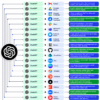
For everyday tasks and general questions, ChatGPT. For writing long documents and front-end code, Claude. For the Google ecosystem and huge documents, Gemini. For real-time social data, Groq. For budget-conscious API usage, DeepSeek. For privacy and local deployment, LLlama. For sourced research, Perplexity. For images, Midjourney. For video, Veo or Kling. For music, Suno. For voice, ElevenLabs. For coding in an editor, Cursor. For building from terminal, Claude Code. For parallel cloud coding, Codex.
Don’t marry one model. Use the right tool for the right job. The people getting the most from AI in 2026 aren’t loyal to one platform. They switch between all of them based on what they’re doing.