

Critical Analysis of the Opportunities, Benefits, and Limitations.
Introduction:
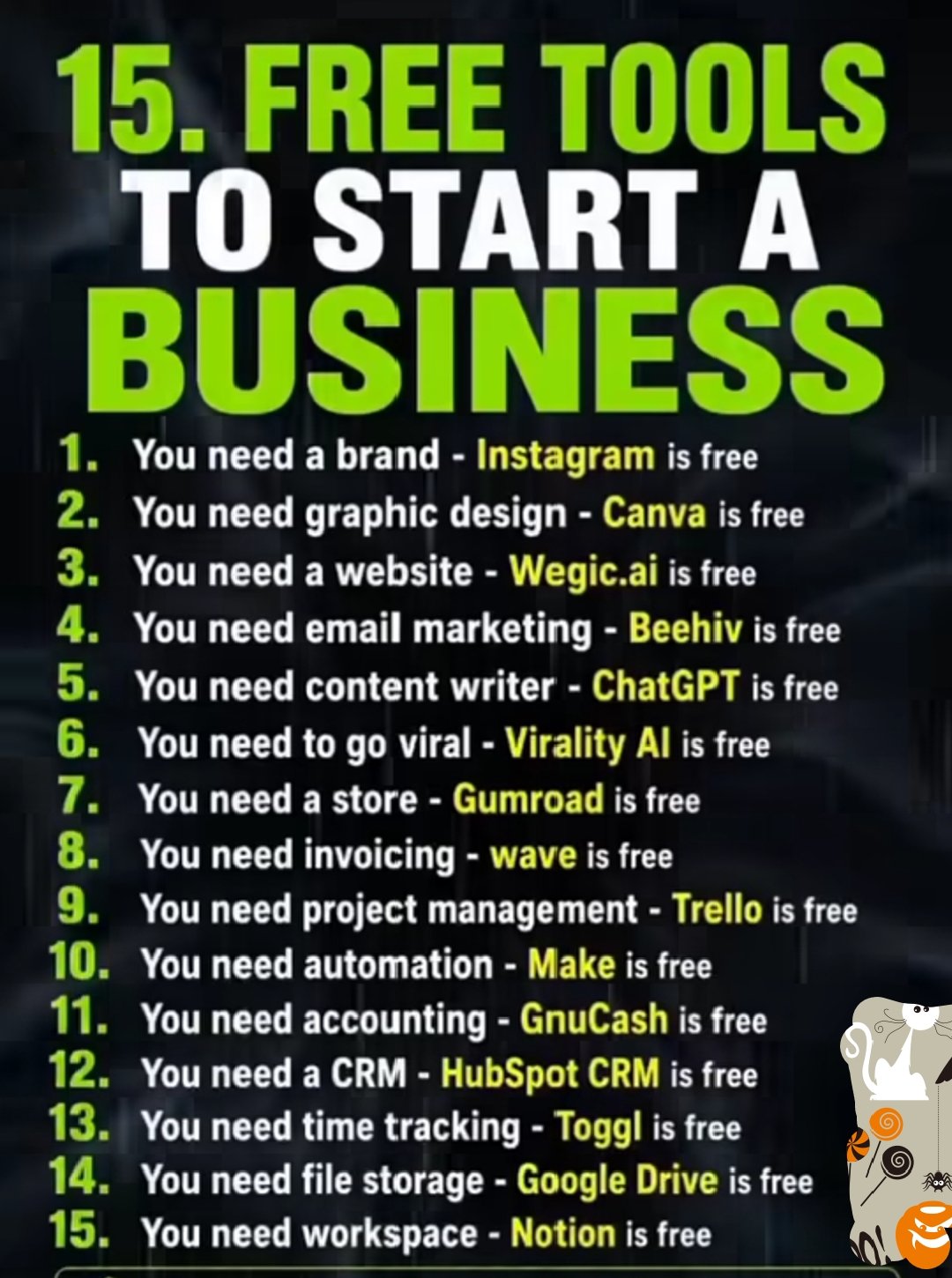
Starting a business has become more accessible because of digital technology, artificial intelligence (AI), and free online tools. The attached image, titled “15 Free Tools to Start a Business,” presents a list of digital platforms designed to help entrepreneurs manage different business activities without making a large initial investment. It highlights tools for branding, graphic design, website development, marketing, accounting, customer relationship management, and productivity. Although the list provides a useful starting point, a critical analysis reveals both its practical value and certain limitations.
Detailed Analysis of the 15 Tools:
The first recommendation is Instagram, which allows entrepreneurs to build a brand, showcase products, communicate with customers, and promote services. It is particularly useful for small businesses targeting customers through visual content. However, organic reach is unpredictable, and consistent content creation requires time and effort.
Canva, the second tool, simplifies graphic design by enabling users to create logos, advertisements, presentations, and social media posts. Its free version is suitable for beginners, although some premium templates and features require payment.
The third tool, Wegic.ai, focuses on website creation through AI-assisted design. It can help entrepreneurs establish an online presence quickly, but businesses should evaluate its free-plan restrictions, customization options, and hosting costs before relying on it.
Beehiiv, listed for email marketing, helps businesses publish newsletters and develop an audience. Its usefulness depends on the business model and whether its free plan supports the required audience size and features.
ChatGPT can assist with content writing, brainstorming, customer communication, product descriptions, and marketing strategies. Nevertheless, AI-generated content requires human review to ensure accuracy, originality, and relevance.
Virality AI is presented as a tool for improving the potential of content to go viral. However, no platform can guarantee virality because audience behavior, content quality, timing, and platform algorithms all influence performance.
Gumroad enables creators to sell digital products, such as ebooks, templates, and online resources.
Wave supports invoicing and financial administration.
GnuCash offers accounting capabilities. Entrepreneurs should carefully evaluate transaction charges, payment availability in their country, tax requirements, and accounting needs before choosing these services.
Trello provides project management through boards, lists, and task cards.
Make helps automate repetitive workflows.
HubSpot CRM organizes customer information, sales activities, and business relationships.
Toggl supports time tracking.
Google Drive provides cloud storage.
Notion combines note-taking, documentation, and workspace organization.
Together, these tools can reduce administrative workloads and help small teams operate more efficiently.
Critical Evaluation:
Are They Really Free?
In practice, free access does not necessarily mean a completely free business solution. Many platforms use freemium models, offering basic features while charging for advanced functionality, greater capacity, integrations, or additional users.
Other important considerations include internet access, data privacy, learning time, platform dependence, and regional restrictions. For example, a business in Pakistan must check payment-gateway compatibility, international transaction costs, and local tax obligations before selecting an online sales platform.
Furthermore, using fifteen different tools simultaneously may create unnecessary complexity. Entrepreneurs need an integrated workflow rather than a large collection of disconnected applications.
Conclusion:
Above data provides a valuable checklist for aspiring entrepreneurs, particularly students, freelancers, and small-business owners with limited budgets. These platforms can reduce initial costs and make professional business management more achievable.
However, successful entrepreneurship depends on more than software. Customer demand, product quality, pricing, cash-flow management, marketing, and consistent execution remain the foundations of a sustainable business. The smartest approach is to select only the tools that solve immediate problems, verify their free-plan limitations, and upgrade only when business growth justifies the expense.